
Brown's Brazilian Jiu-Jitsu
One School - One Family
Frequently asked questions
Are you new to BJJ and/or martial arts in general? Check out some of our frequently asked questions to help you get started!
what do i wear?
Traditionally, BJJ practitioners wear a Gi. Some schools and competitions have strict requirements on color (e.g. only white for students, only white, black, or blue for competition, etc). There is also no-gi bjj where a fitted rash guard and grappling shorts or compression spats (no pockets/zippers) are worn. If you are looking for how to pick a Gi, this article explains why lightweight Gis are popular among many competitors.
What are the main BJJ styles?
-
Gi: Training in a traditional, heavy cotton uniform called a gi or kimono. The fabric is used to grip, control, and submit opponents, which creates a slower, highly technical game.
-
No-Gi: Training in athletic shorts and a synthetic shirt (rash guard). Without a uniform to grab, the pace is significantly faster and relies heavily on wrestling, speed, and positional control.
Do I need to be in shape to start?
-
No, you do not need to be in shape to start BJJ. Many academies feature introductory programs, and the sport itself is a full-body workout that improves cardiovascular endurance, strength, and flexibility over time.
Will I get injured?
-
While BJJ is a full-contact combat sport, it is generally very safe when trained responsibly. The focus on submissions allows practitioners to “tap out” before any real harm or joint locks are fully applied. Most injuries happen due to accidents or ego; choosing good training partners and controlling the intensity significantly reduces your risk.
How do belts work?
-
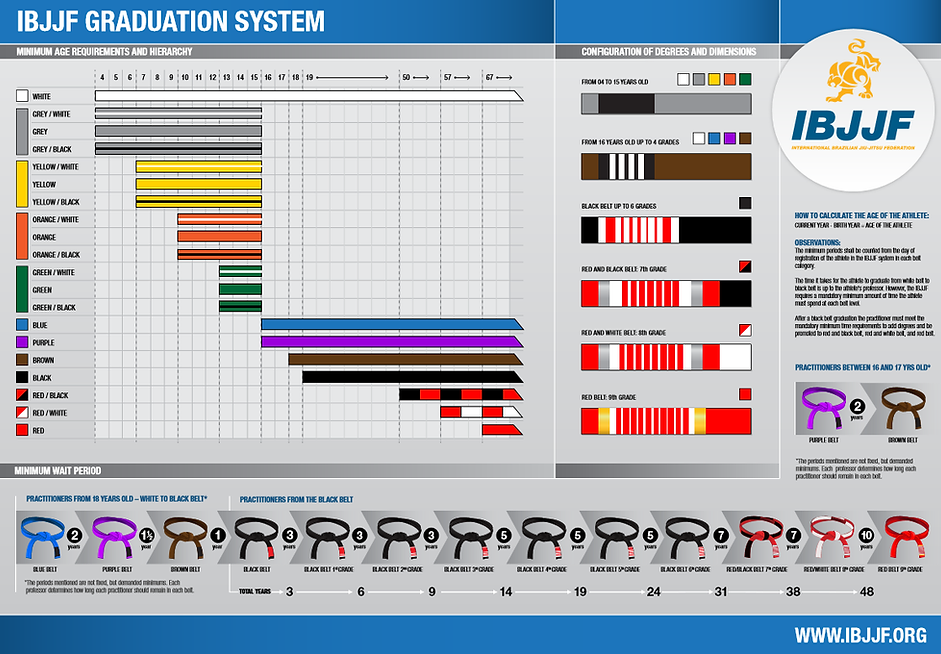
Unlike arts where kids earn black belts quickly, BJJ is notorious for how difficult they are to achieve, typically taking 10 to 12 years of consistent training.
-
The belt order for adults (16+) is:
-
White
-
Blue
-
Purple
-
Brown
-
Black
-
-
The belt order for youth (5-16) is:
-
White
-
Grey-White/Grey/Grey-Black
-
Yellow-White/Yellow/Yellow-Black
-
Orange-White/Orange/Orange-Black
-
Green-White/Green/Green-Black
-
Do I have to compete?
-
No. While competing is an excellent way to test your skills against students from other academies, a large percentage of BJJ practitioners train strictly for fitness, self-defense, and the social aspect.